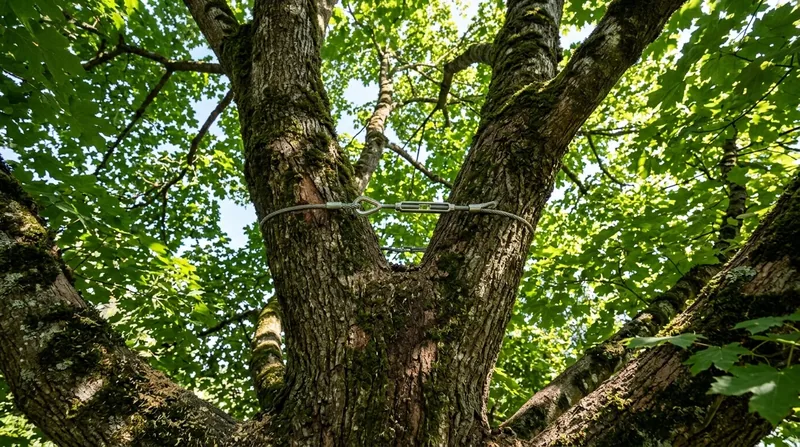




Tree cabling and bracing in Richmond is a structural support system that saves valuable trees from removal when they develop a weakness. Large maples, oaks, and birches across Richmond often grow with co-dominant trunks or heavy limbs that lean under wind and ice load. Rather than cut them down, our ISA Certified Arborists install steel cables and braces high in the canopy to redistribute stress and keep the tree standing safely for decades. This service is especially useful on ravine lots where mature trees anchor slope stability, or in post-war subdivisions where street trees have grown too large for their original space. We have been cabling and bracing trees in Richmond since 2011, and the technique works best when installed before a tree fails. Call us at (778) 652-1933 for a free estimate, or visit our main site to learn more about our full range of tree services.
Why cabling and bracing prevents costly removal
A tree with a structural weakness is not automatically a candidate for removal. If the tree is healthy, valuable, and located where its loss would harm the landscape or stability of your property, cabling offers a proven alternative. Bracing works by supporting the weak point so that wind, ice, and snow loads are shared across the cable system rather than concentrated on the vulnerable limb or fork. Our crews assess each tree individually, measuring lean angles, limb diameter ratios, and wood condition to determine whether cabling will extend the tree's safe lifespan.
- We inspect the fork or limb for internal decay and structural integrity before any cable goes in.
- We select cable gauge and brace type based on limb weight and the expected wind load in your area.
- We install hardware at least two-thirds of the way up the canopy to maximize mechanical advantage.
- We document the installation with photographs for your records and for any future arborist.
Cabling is not a permanent fix, but it is a long-term one. Most cable systems remain effective for 10 to 15 years with periodic inspection.
Local example: A mature red oak on a Richmond ravine lot developed a co-dominant trunk after heavy ice in a previous winter. Removal would have cost $3,500 to $5,000 and destabilized the slope. Cabling and bracing cost $1,200 to $1,600 and allowed the tree to stand safely. The owner avoided a much larger site restoration bill.
How we install cables and braces in the Richmond area
Our installation process is methodical and safe. We begin with a ground-level assessment, measuring limb angles and identifying the exact points where cables will anchor. We then climb into the canopy using rope and harness, secure ourselves to sound wood, and mark the attachment points with precision. All hardware is installed with bolts that pass completely through the limb to avoid girdling the bark, and cables are routed to avoid crossing foliage or rubbing on branches. The entire job typically takes one to two days depending on tree height and canopy complexity.
- We use certified climbing equipment and fall protection every time we ascend the tree.
- We drill anchor points with care to avoid hitting internal decay or hollow sections.
- We tension cables to the correct specifications using a load cell or dynamometer.
- We trim any dead or crossing branches that might interfere with the cable system.
- We clean up all debris and haul away wood chips unless you prefer them for mulch.
After installation, we recommend an inspection every two to three years. Over time, cable tension may loosen slightly, and new growth in the canopy can shift the load distribution.
Real scenario: A silver maple in West Vancouver with a 45-degree lean toward a fence required two cables installed 4.5 metres and 6 metres up the trunk. Installation took 6 hours, including rope setup, anchor drilling, cable routing, and cleanup. Cost was $1,400. Without cabling, the tree would have failed within two years.
Cable systems and brace types we use
| Cable or Brace Type | Description | Best For |
|---|---|---|
| Static cable (7/16" steel) | High-strength galvanised steel cable installed with eye bolts, distributes load across two or more anchor points. | Co-dominant trunks, heavy side limbs, trees on slopes. |
| Dynamic cable (elastic core) | Cable with shock-absorbing properties that flex slightly under wind load, reducing sudden stress on anchors. | Tall trees in exposed locations, trees prone to wind damage. |
| Rigid brace (threaded rod) | Metal rod with bolted connections, holds limbs in a fixed position with no flex. | Horizontal limbs that droop, limbs very close to structures. |
| Combination system | Two or more cables and braces working together to support multiple weak points on the same tree. | Large mature trees with multiple structural issues, ravine trees under stress. |
The choice of system depends on the tree species, limb angle, wind exposure, and proximity to buildings or utilities. Our arborists will recommend the right approach during the free estimate. Learn more about our arborist assessment process to understand how we evaluate your tree's specific needs.
Permits and safety near hydro lines in Richmond
The City of Richmond may require a permit for work on private trees, especially if the tree is large or located near a property line. An arborist report supporting your application strengthens the permit case and shows the municipality that a qualified professional has assessed the tree. We can prepare this report as part of our service. Regarding hydro lines, we work safely around the private service entrance to your home, respecting all approach distances. We never work on the public medium- or high-voltage distribution network operated by BC Hydro. If your tree is near hydro lines, we coordinate with the utility and follow their clearance requirements to the letter. Our fully insured crews carry comprehensive liability coverage and workers' compensation insurance, so your property and our crew are protected throughout the job. Contact us at (778) 652-1933 or visit our contact page to discuss any permit questions before we begin.
When to cable your trees
The best time to install cabling is late fall through late winter, when trees are dormant and the canopy is bare. This timing allows our arborists to see the full structure of the tree, identify weak points clearly, and work safely without navigating dense foliage. Winter also means less sap flow and reduced stress on freshly drilled anchor points. However, if a tree develops a dangerous lean or a limb breaks during summer or after a storm, we can install emergency cabling year-round. Do not wait if a limb is hanging or a trunk is visibly cracked. Call us immediately at (778) 652-1933 for emergency stabilisation. Our 24/7 response team can often reach properties in Richmond and the surrounding area within hours.
For trees with multiple structural issues or those in high-risk locations such as ravine lots, we recommend a professional inspection every two to three years. Early detection of problems like bark inclusion or internal decay can prevent a sudden failure. If you are unsure whether your tree needs cabling, contact us for a free estimate. We will assess the tree, explain the options, and provide a clear recommendation without pressure to over-treat.
Learn more about our structural and seasonal pruning services, which often work hand in hand with cabling to reduce canopy weight and improve tree health over time.
Why choose Vancouver Tree Trimming for cabling and bracing
We are a local, fully insured company with ISA Certified Arborists on staff. Since 2011, we have installed hundreds of cable systems on trees across Richmond, West Vancouver, Delta, and the surrounding municipalities. Our arborists understand the species common to in Richmond and the surrounding area, from silver and sugar maples to red and white oaks, and they know how each species responds to structural support. We use only certified climbing equipment and industry-standard hardware. Every installation is documented with photographs and a written report that you can share with future arborists or your municipal permit office. We stand behind our work and remain available for follow-up inspections and adjustments. For a free estimate or to discuss your tree's specific situation, call (778) 652-1933 or visit our pricing page to see the full range of our services and costs.
Prices Tree Cabling & Bracing in Richmond — Indicative pricing
| Service | Price | Details |
|---|---|---|
| Small limb cabling (single cable, under 20 cm diameter) | From $800 | One cable system with two anchor points, includes inspection and documentation. |
| Standard cabling (co-dominant trunk or large limb, 20 to 40 cm diameter) | From $1,200 | Two cables with multiple anchors, full climbing setup, cleanup included. |
| Complex cabling (multiple weak points, rigid braces, or height over 15 metres) | From $1,800 | Combination systems, extensive rigging, arborist report available. |
| Follow-up inspection and cable tensioning | From $400 | Yearly or bi-yearly check to ensure cable tension and anchor integrity. |
| Arborist report (for permit or insurance documentation) | From $350 | Professional assessment, photographs, structural analysis, and recommendations. |
| Free estimate | No cost | On-site evaluation, cable system recommendation, and firm quote. Call (778) 652-1933. |
Indicative prices; free, personalized estimate within 24h at (778) 652-1933.