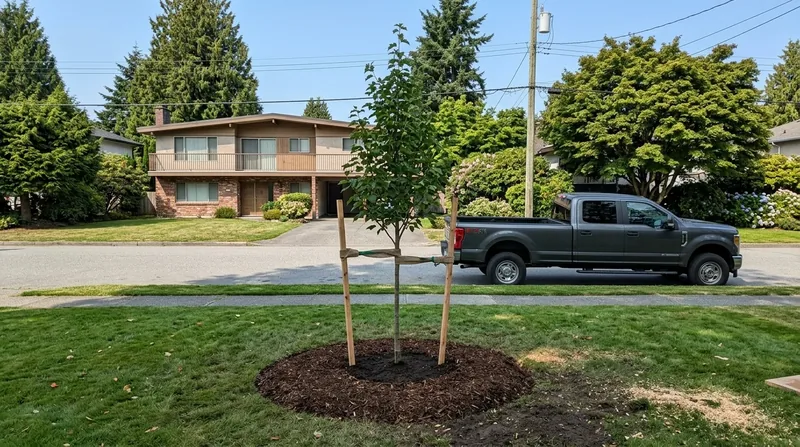




Tree planting in Richmond transforms a bare yard into a mature landscape, but success depends on choosing the right species for coastal in Richmond and the surrounding area's climate, soil conditions and light exposure. Our ISA Certified Arborists recommend trees suited to your lot's specific environment, then handle site preparation, planting and staking to give your new tree the strongest possible start. Whether you're replacing a tree we removed or adding shade to a new property, we ensure proper root establishment and long-term health from day one.
Richmond's mix of post-war subdivisions, newer developments and ravine properties each present distinct challenges. Mature yards have compacted soil and established root systems from neighbouring trees. New construction sites often lack topsoil depth. Coastal exposure brings salt spray and wind stress. We assess all these factors before recommending species and techniques tailored to your specific site.
Why proper tree planting matters in the Richmond area
A poorly planted tree struggles from the outset. Root collar buried too deep invites rot and girdling roots. Inadequate staking allows excessive movement that damages the root system. Wrong species for your light and soil conditions means decades of stunted growth or premature decline. Our approach eliminates these common mistakes.
We handle the full process to give your new tree every advantage:
- Assess your lot's light, drainage, soil texture and existing root competition.
- Recommend species proven in coastal in Richmond and the surrounding area, such as silver maple, red oak, birch or Norway spruce.
- Prepare the planting pit to proper depth and width, breaking compacted soil.
- Plant with the root collar at or slightly above grade to prevent rot.
- Stake and guy for stability without girdling the trunk.
- Mulch the root zone to retain moisture and moderate soil temperature.
Proper planting cuts establishment time in half and dramatically reduces the risk of decline or failure. A well-planted tree thrives; a hastily planted one may never recover.
Key info: In Richmond neighbourhoods with mature soil and high water tables, we often amend planting pits with coarse sand and perlite to improve drainage. A 15-year-old oak planted this way outgrows a poorly drained neighbour by 30 percent in crown spread and trunk diameter.
Our planting process step by step
Every tree planting begins with a site visit to evaluate soil, light, proximity to structures and utilities, and your long-term vision for the yard. We then source nursery stock suited to those conditions and execute a methodical planting that sets the tree up for decades of healthy growth.
Here is how we work:
- Locate underground utilities (call BC One Call) to avoid hitting hydro service lines, gas or water.
- Dig the planting pit 1.5 times the root ball width and to the same depth as the root collar.
- Loosen the sides and bottom of the pit to encourage root outgrowth into surrounding soil.
- Backfill with amended soil, settling it gently to eliminate air pockets.
- Install tree stakes or guy wires if the tree is tall, exposed to wind or in a high-traffic area.
- Apply 5 to 7 centimetres of mulch around the root zone, keeping it 5 centimetres clear of the trunk.
- Water thoroughly and establish a watering schedule for the first two growing seasons.
We remove all stakes and guy wires after 12 to 18 months, once the root system is established enough to anchor the tree against typical wind loads. This gradual transition strengthens the tree's structural stability.
Example: A customer in Delta replaced a 40-year-old silver maple with a new 5-centimetre diameter specimen. We amended the pit with 30 percent sand and 20 percent compost to improve drainage in their clay-heavy lot. After three years, the new tree had already reached 7 centimetres diameter and filled 60 percent of the canopy space the original occupied.
Species selection for the Richmond area
in Richmond and the surrounding area's coastal climate supports a diverse palette of trees, but not all perform equally on every Richmond lot. We recommend species based on mature size, soil tolerance, pest and disease resistance, and seasonal interest. Common excellent choices include sugar and silver maple for shade, red and white oak for longevity and structure, birch for light and movement, and Norway spruce for windbreaks and privacy.
Native and adapted species thrive with less maintenance:
- Sugar maple and red oak establish deep root systems and tolerate both wet and dry periods once mature.
- Birch species bring elegant branching and white bark, though they prefer well-drained soil.
- Norway spruce provides year-round structure and wind protection on exposed sites.
- Black locust tolerates poor soil and compaction, making it ideal for disturbed lots or new construction.
- Fruit trees such as apple, pear and cherry suit yards where you want edible production alongside ornamental value.
We avoid species prone to pests or diseases in this region, such as ash (vulnerable to emerald ash borer) unless you commit to annual preventive treatment. Our goal is a tree that thrives with minimal intervention for 50 years or more.
| Species | Mature Height | Best Use | Soil Tolerance |
|---|---|---|---|
| Sugar Maple | 18 to 25 metres | Large shade tree, fall colour | Well-drained, moderate moisture |
| Red Oak | 20 to 27 metres | Shade, structure, longevity | Adaptable, tolerates clay |
| Birch | 15 to 20 metres | Light, movement, ornamental bark | Well-drained preferred |
| Norway Spruce | 20 to 30 metres | Windbreak, privacy, year-round form | Adaptable, prefers cool moist sites |
Permitting and site access in Richmond
Tree planting itself rarely requires a municipal permit in Richmond. However, if your planting is part of a larger site alteration (such as grading, fill or drainage work), the City of Richmond may require a development permit or engineering review. Our team handles all logistics and communicates with municipal authorities when necessary. We also respect approach distances from private electrical service entrances and never work on the public BC Hydro distribution network.
Site access shapes our approach. Many Richmond properties have narrow gates and tight backyards reachable only by hand tools and wheelbarrows. We plan accordingly, staging materials efficiently and removing soil and debris without damaging adjacent landscaping. For larger projects or ravine lots with steep terrain, we coordinate equipment access and slope stability to ensure safe, clean execution.
If you need an arborist report and risk assessment to support a municipal application or to document existing trees before construction, we provide that service as well. Our ISA Certified Arborists assess tree health, structural integrity and hazard potential, giving you and the City confidence in your site plan.
Aftercare and long-term success
The first two years after planting are critical. We recommend consistent watering during dry spells, careful mulching to retain soil moisture, and removal of competing weeds. We also prune any broken or crossing branches and monitor staking to ensure it is not girdling the trunk as the tree grows.
After two years, most trees are established enough to thrive on natural rainfall in the Richmond area. However, if you want ongoing health monitoring or structural pruning as the tree matures, we offer structural and seasonal pruning services. Early pruning shapes the tree's form and reduces the need for corrective work later.
For questions about your specific site or to schedule a free planting consultation, call us at (778) 652-1933 or visit our contact page to request a free estimate. We serve Richmond and the surrounding municipalities with the same care and professionalism we have brought to tree care since 2011.
Prices Tree Planting in Richmond — Indicative pricing
| Service | Price | Details |
|---|---|---|
| Small tree planting (up to 5 cm diameter) | From $200 | Includes site prep, planting, staking, and mulching |
| Medium tree planting (5 to 10 cm diameter) | From $350 | Soil amendment, structural staking and 24-month monitoring plan |
| Large specimen planting (over 10 cm diameter) | From $600 | Extensive site preparation, advanced staking and premium aftercare |
| Arborist consultation and species recommendation | From $150 | On-site assessment of light, soil, drainage and long-term suitability |
| Site access and material staging | Included | In Richmond and the surrounding area |
| Free estimate | Free | Response within 24 hours at (778) 652-1933 |
Indicative prices; free, personalized estimate within 24h at (778) 652-1933.