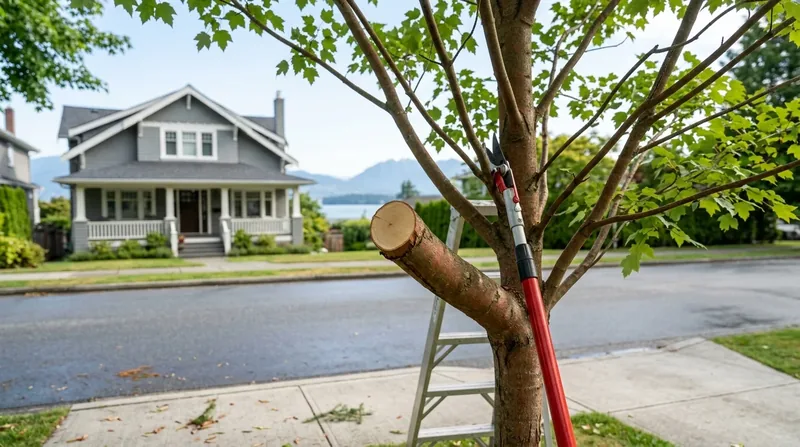




Structural and seasonal pruning in Richmond corrects weak branch structure before trees develop serious defects, timed to dormancy so they heal cleanly and put out strong new growth instead of crowding regrowth. Richmond's mature maples, oaks and spruces on residential lots and in post-war subdivisions carry risk from crossing limbs, narrow crotches and overextended branches that snap under ice or wind load. Our ISA Certified Arborists assess each tree's form, species and site conditions, then prune to reduce future failure risk while preserving the crown shape and vigour. We work in late fall through late winter when trees are dormant and branch structure is visible without foliage, minimising wound stress and allowing proper compartmentalisation. Trimming and structural work done at the right season means faster healing, lower disease risk and a stronger tree for decades to come.
Why structural pruning prevents costly failures
Trees in Richmond neighbourhoods often develop weak forks, crossing limbs and branches that extend too far from the trunk. These defects rarely cause problems when trees are young and wood is supple, but as trees age and weather events intensify, weak structure becomes a liability. A branch failure can damage a roof, a fence or a car parked below, or worse, injure someone on your property. Structural pruning removes or reduces limbs that compete for dominance, tightens crotch angles and shortens overextended branches before they become a hazard. The work is preventive, not reactive, and costs far less than emergency removal or property repair after a failure.
- Remove crossing and rubbing limbs that weaken both branches.
- Reduce limbs that extend beyond the branch collar, increasing leverage and failure risk.
- Thin crowns to lower wind resistance and reduce ice load on weak crotches.
- Correct co-dominant stems competing for dominance, leaving one clear leader.
- Prune to preserve natural branch angles and the tree's inherent form.
Structural work done correctly means your tree grows stronger, not weaker, and the risk of failure drops significantly over the next 10 to 15 years.
Local example: A 40-year-old silver maple in Richmond with a narrow crotch and two co-dominant stems often costs $400 to $600 in preventive structural pruning. Without that work, a single ice storm or windstorm can trigger failure and a $2,500 emergency removal plus roof damage. Early intervention saves money and protects your property.
How we assess and prune your trees in the Richmond area
Our arborists begin by inspecting each tree for weak structure, disease, pest damage and site stress. We look for narrow crotches, co-dominant stems, deadwood, crossing limbs and branches growing inward or downward. We measure branch angles, assess wood quality and estimate the weight distribution in the crown. Then we develop a pruning plan specific to that tree's species, age, site and your goals. We prune to remove or reduce only what creates genuine risk, preserving as much healthy crown as possible so the tree retains vigour and continues to provide shade and screening.
- Inspect the tree for weak forks, crossing limbs, co-dominant stems and deadwood.
- Assess the crown balance, branch angles and load distribution.
- Identify branches that create risk due to their size, position or angle.
- Prune using proper technique: cut just outside the branch collar, never flush or leaving a stub.
- Remove all pruning debris and chip branches on site or haul away, leaving your yard clean.
The result is a tree with clearer structure, better internal light penetration and lower failure risk, all while maintaining its natural form and canopy density.
Concrete case: A 35-year-old red oak in a Richmond backyard with a dense crown and two competing main stems. Structural pruning removes the weaker stem at the base, reduces three overextended lower limbs and opens the interior to air flow. Cost runs $350 to $500. The tree is now more stable, sheds less debris and has 20+ more years of healthy growth ahead.
Timing and seasonal considerations
Trimming and structural pruning are best done in dormancy, from late fall through late winter, when trees are leafless and branch structure is fully visible. Pruning during dormancy minimises stress, reduces disease entry points and allows the tree to compartmentalise wounds quickly once growth resumes in spring. Winter work in Richmond is ideal because trees are not expending energy on new growth, and sap flow is minimal. We avoid pruning in late spring and summer when trees are actively growing, as fresh cuts attract insects and disease, and the tree wastes energy healing wounds instead of strengthening new wood. Emergency pruning of broken or hazardous branches can happen any time, but routine structural work waits for the dormant season.
- Late fall to late winter: optimal window for structural and routine pruning.
- Avoid pruning in late spring and summer when trees are in active growth.
- Late spring to early summer: best for cedar hedge trimming and emerald ash borer treatment.
- Year-round: emergency removal of broken, diseased or hazardous branches.
Timing your pruning correctly ensures faster healing, stronger regrowth and maximum benefit from the work we do.
Pruning methods and tools
| Method | Description | When used |
|---|---|---|
| Crown thinning | Remove 10 to 20 per cent of live branches throughout the crown to reduce weight and improve light penetration. | Routine maintenance on dense crowns, especially maples and oaks. |
| Structural pruning | Remove or reduce branches that create weak structure, crossing limbs or co-dominant stems that compete for dominance. | Young to mature trees with visible defects or poor form. |
| Crown raising | Remove lower branches to clear sight lines, improve pedestrian or vehicle access, or reduce wind resistance near structures. | Trees overhanging driveways, walkways or roofs in tight Richmond lots. |
| Deadwooding | Remove all dead, diseased or dying branches throughout the crown. | Every pruning job as part of structural assessment and cleaning. |
| Reduction pruning | Cut back branch tips to a lateral branch or bud to reduce crown size and weight without removing entire limbs. | Mature trees that have outgrown their space or overextended limbs over structures. |
All cuts are made just outside the branch collar using sharp, clean equipment. We never leave stubs, never cut flush to the trunk, and never apply wound dressing unless the tree is under extreme stress. Proper cutting technique allows the tree to seal the wound naturally and compartmentalise decay.
Permits, insurance and site cleanup in Richmond
The City of Richmond may require a permit for a private tree removal, and an arborist report typically supports that application. Permit rules and thresholds differ from one municipality to the next across the Richmond area, so we always advise you to check with your local planning office before beginning work. Our team is fully insured for liability and property damage, and we carry certificates of insurance on every job. We respect approach distances near private electrical service entrances and never work on the public distribution network of BC Hydro. All debris is chipped on site or hauled away, leaving your yard clean and ready to use. We can provide documentation of the work completed for your records or insurance claim if needed.
Call us at (778) 652-1933 for a free estimate on structural pruning, or visit our arborist report page if you need a formal assessment for a permit application. For more details on crown reduction and routine trimming, or to learn about storm and deadwood branch removal, explore our full service menu. We also offer tree disease diagnosis if you suspect a health issue, and we are happy to provide a free quote for any work you have in mind.
Prices Structural & Seasonal Pruning in Richmond — Indicative pricing
| Service | Price | Details |
|---|---|---|
| Small tree structural pruning (up to 25 feet) | From $230 | Pruning of crossing limbs, weak forks and deadwood on small residential trees |
| Medium tree structural pruning (25 to 45 feet) | From $450 | Crown thinning, codominant stem reduction and branch shortening on mature trees |
| Large tree structural pruning (45+ feet) | From $750 | Complex structural work on tall oaks, maples and spruces requiring heavy equipment |
| Multiple trees or combined services | Custom quote | Structural pruning bundled with deadwooding, crown raising or hedge trimming |
| Travel | Included | No charge for travel in Richmond and the surrounding area. |
| Free estimate | Always free | Call (778) 652-1933 for an on-site assessment with no obligation |
Indicative prices; free, personalized estimate within 24h at (778) 652-1933.